In March twenty-one schoolmates from Harvard Kennedy School (HKS) and I left the Cambridge cold for the North Africa gateway to the West: Morocco.
We were led by two classmates, one a native Moroccan and one a French-Moroccan. Our group represented 15 countries (Brazil, Canada, Colombia, Chile, China, Cuba, India, France, Germany, Morocco, Peru, Singapore, Thailand, Peru, United States) and spoke 11 languages (Arabic, English, French, German, Hebrew, Hindi, Mandarin, Portuguese, Spanish, Tamil, Thai).
Short History of Morocco
Native Moroccans are known as Amazigh, or as the Romans called them, Berber, meaning barbarian. Natives are most commonly known as Berber, and their language is also called Berber which has five major dialects. The official and most common language is an Arabic dialect called Darija. Almost all government officials and major businesses speak French as well. It was not uncommon in the souks (traditional Berber market) to hear Arabic, French, Spanish, Italian, and English all from the locals.
Originally Morocco was known as Mauritania. The Amizagh traded with Phoenicians via the Mediterranean to the north and Carthaginians via the Saharan interior to the east before being occupied by the Romans. The Romans called the western end of their empire Mauritania Tingitana with its capital in Volubilis, which eventually lost importance leading to Tangiers becoming the capital. Religions were Christianity and Judaism, though the majority of Berbers maintained cultural paganism, until the Arabic conquests in the 7th century when the major organized religion became Islam.
The Arabs called Morocco al-magrib (the West). Incidentally, inhabitants of the Maghreb (the great Arab West, at one time encompassing all of North Africa) were known as Moors. Arab occupied Spain was included in the Maghreb which is why Spanish Muslims were called Moors by Christians during the Crusades.
The Berbers revolted and Morocco devolved into statelets led by local rulers following locally defined versions of Islam. Local rulers were replaced and consolidated as major dynasties gained and lost power, until the Alaouite dynasty gained power in 1631, claiming to be descendant from the prophet Mohammed. The Arab Alaouite sultans attempted to foster trade especially with Europe, but got entangled with continental conflicts which eventually resulted in Morocco becoming a French protectorate from 1912-1953. Mohammed V was the exiled sultan during French occupation and established the Kingdom of Morocco upon gaining independence.
Why this long history? Morocco is a very diverse country. Berbers, roman descendants, Arabs, European expatriates and Jewish refugees all make up multiple groups of “natives.” Though the truthful locals make it known that inter-religious violence is not tolerated by order of the king, it is interesting to see multiple forms of Islam coexisting with multiple forms of Judaism alongside Christianity. Despite having many political rulers, the Berbers are fiercely independent and proud that they have never been “conquered." Even during the French protectorate, Morocco has acted very independently, sort of just allowing these outsiders to believe they are in charge.
Moroccans are very proud of their social and religious diversity (part of their national anthem includes “land of tolerance”) which they feel was most embodied historically by their ability to remain resilient and defiant of the Vichy French and Axis powers during World War II. As made famous in the movie (though the movie was shot in Tangier) Moroccan port cities, especially Casablanca, became the last available point of debarkation for continental European refugees. Gaining independence from France was the last effort in expelling the remnants of the Vichy influence. All this aside, the fact that Moroccans are most proud of telling is that in 1777 Morocco was the very first country to recognize the independence and establishment of the United States of America.
Okay, on to the fun stuff. I included this background because everything we saw, whether it was a souk, a garden, a mosque, a palace or a casbah, has multiple layers of stories and it is impossible to tell them all.
Marrakech
We
landed in Casablanca and immediately boarded a bus to start our trek to
Marrakech. Marrakech is home to Jamma el Fna, one of the largest Berber
souks (market), the Saadian dynasty
royal tombs, the Ben Youssef Mederesa (religious school), El Bahia Palace and
is one of the most important of the four former imperial cities. We also saw
the Koutoubia Mosque, the Mellah (an old Jewish quarter) and Jardin Marjorelle,
a global garden created by a French artist Jacques Marjorelle. We also scooter toured the city including the medina (old city) and were
treated to some amazing dinners with entertainment!
 |
| The only Arabic word I can read. I think its "Share canoe in case of flood" |
 |
| Prepping for our Berber horseman show dinner |
 |
| Berber "medieval times" |
 |
| Amazing what a few dirham will buy |
 |
| Fist pumping at the Euro-style clubs |
 |
| Mugging at Jardin Marjorelle |
 |
| Best way to tour the city |
 |
| Monkeying around in Jamma el Fna |
 |
| Koutboubia Mosque |
 |
| Berber Whiskey - warm sweet tea with mint (no actual whiskey) |
 |
| Gate to the Medina |
Ouarzazate
We drove from Marrakech over the High Atlas Mountains at its highest peak, Tizin Tichka. The land went from urban to arable flatland to mountainous in the course of a couple hours driving. After the High Atlas we descended into the Valley of the Casbahs. Casbahs are forts, and this valley was known to be especially lawless, requiring each locality to have its own protected area. we then entered Ouarzazate, known as the
door of the desert, but also as the film capital of Morocco. Many movies were filmed in and around the town, especially as the UNESCO World Heritage Site, the fortified village (
ksar) of Ait Benhaddou. Lawrence of Arabia, The Living Daylights, The Last Temptation of Christ, Indiana Jones and the Raiders of the Lost Ark, Gladiator, and even some scenes of the current show Game of Thrones were all filmed here.
 |
| Chivin' on St Paddy's on top of the Atlas Mountains |
 |
| Looking over Ait Benhaddou |
 |
| One picture of all the males. The ladies were hogging the pics. |
 |
| Contemplating the best way to ford the river. |
 |
| Partial Film List |
 |
| Simba was unavailable |
 |
| Might have actually been sleeping while this was taken |
 |
| Two man integrity on all weapons |
Merzouga
More driving from Ourzazate to Merzouga, a town on the edge of the Sahara desert. A lot of the trip was seen "along the way" in a style LTD would much appreciate. We saw the Berber town of Azrou, famously known for its carpets on our way to camel rides in the Sahara dunes. One of the best night sof the trip was spent sleeping in tents under the Saharan stars. It was romantic enough that two of our trekkers got engaged that evening. Much wine was had, many stories were told. The highlight of the night, at least for my travel mates, was me trying to communicate with our Berber guides through a mix of Arabic, Spanish and Italian. I was actually amazed at how successful we were, though I'm pretty sure they just thought I was crazy.
 |
| Post-lunch soccer in the gorge |
 |
| Kheterra system of wells bringing water from the mountains to the desert |
 |
| Riding out to the campsite |
 |
| Saharan sunset |
 |
| Newly engaged (after some help from us) |
 |
| Storytelling |
 |
| We replaced Berber whiskey with real wine |
 |
| The sunrise was awesome... |
 |
| But was the hangover worth it? |
 |
| Our campsite |
 |
| Best pic of the trek |
Errachidia, Midelt, Middle Atlas Mountains, Ifrane
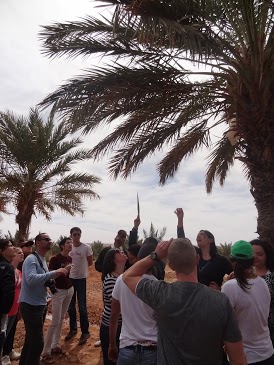
We left the Sahara for the long drive to Fes. We broke it up by spending the night in Midelt. Along the way we learned about the kheterra well system, preventing desertification of arable land, and the life of a date palm and its delicious fruit, dates. By the way, if you eat a date in the U.S. 8 times of of 10 its from Morocco. The big delicious ones CMD finds in California? Moroccan. This region is called Tafilalet, and its main town, Errachidia, was once an obligatory stop for gold and salt caravans - the last stop before trekking the Sahara east and southward. I like Midelt a lot, it had the feel of a frontier town, and the Berber inhabitants were very gracious to the two of us that ventured out on our own after dark. Our interactions with these locals was a highlight of the trip. We also passed through Ifrane, a ski town in the Middle Atlas mountains after spending the night in Midelt and before arriving in Fez.
 |
| There are male palms and female palms. Believe it or not, natural wind pollination required to produce dates is rare. Pollination is done by hand in order to create a profitable yield. |
 |
| In Florida we want to keep the sand on the beach to prevent erosion. The same "technology" is used to keep the desert away from arable land in an attempt to prevent desertification. |
 |
| This women's cooperative was learning how to better package and market the date yield rather than selling raw fruit at cheaper prices. |
 |
| High on life. And dates. And Berber whiskey. Sugar overload. |
 |
| Signing the guest book with a Harvard stamp. |
 |
| Lions used to range the Middle Atlas Mountains. Petting this one brings you luck they say. |
Fes
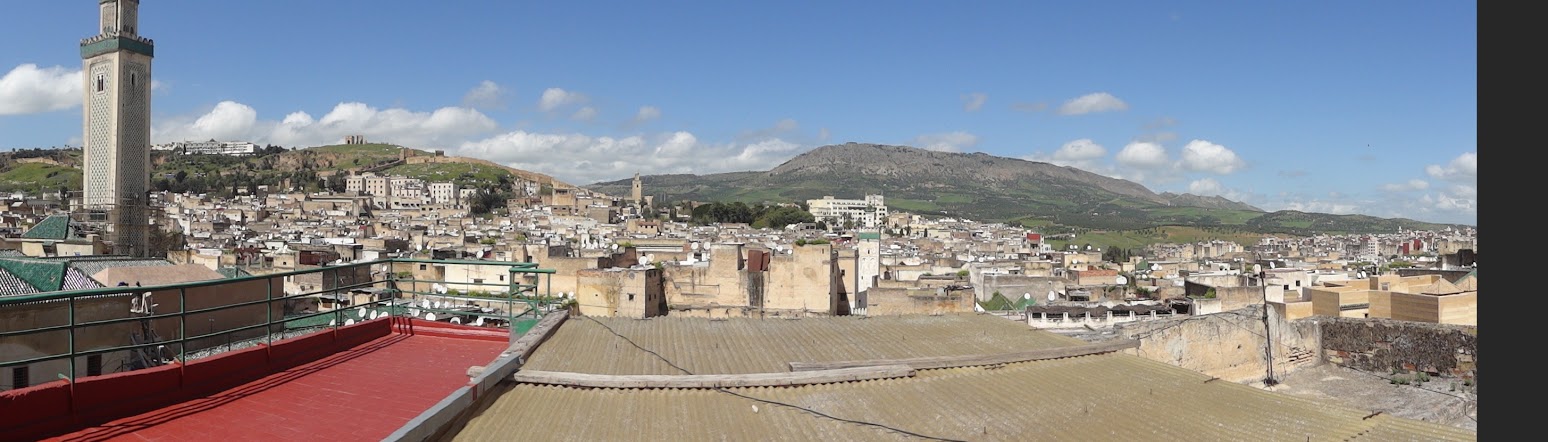
Fes is the spiritual heart of Morocco. It is hard to describe this city, you just sort of get surrounded by it. Bustling urban areas in the new city, souks in the old city, and the smallest alleys I've ever seen in the oldest part of the city. Fez el Bali, the world's largest living Islamic medieval city, is Morocco's first World Heritage Site and the largest car-free urban environment on the planet. We saw the Kairouine Mosque and University, the Chouwara Tannery, the Bou Inania Medersa: Bou Inania Medersa. The pictures barely capture our experience there.
 |
| Fez looking North |
 |
| Fez looking South |
 |
| King Mohammad VI's palace gates |
 |
| Jewish Quarter |
 |
| School let out as we walked through the old city |
 |
| Gate to the Medina |
 |
| Outdoor Mosque |
 |
| The Tannery |
 |
| Making tajins |
 |
| Hand hammering out tiles |
 |
| Pickup futbol after school |
Rabat
Rabat is the administration capital, very cosmopolitan and European. We met with administration officials and private sector innovators here and in Casablanca, and they were very informative on how to continue Morocco's peaceful growth, continuing democratization, and focusing on their African neighbors for the future versus Europe. We saw Chellah, and ancient Roman site, the remains of the Hassan mosque, and the Alaouite kings mausoleum in between our meetings.
 |
| Hassan unfinished mosque minaret |
 |
| Mausoleum |
 |
| The kings are well taken care of |
 |
| Old mosque wall framing the Hassan minaret |
 |
| Sort of the Arlington for the Alaouite kings |
 |
| Rabat would have been LTD's favorite, as it is the Blue City |
 |
| Joking on the port fort wall |
 |
| Gate to the King's Rabat palace, where the administration works. No pictures inside. We're VIP. |
Casablanca
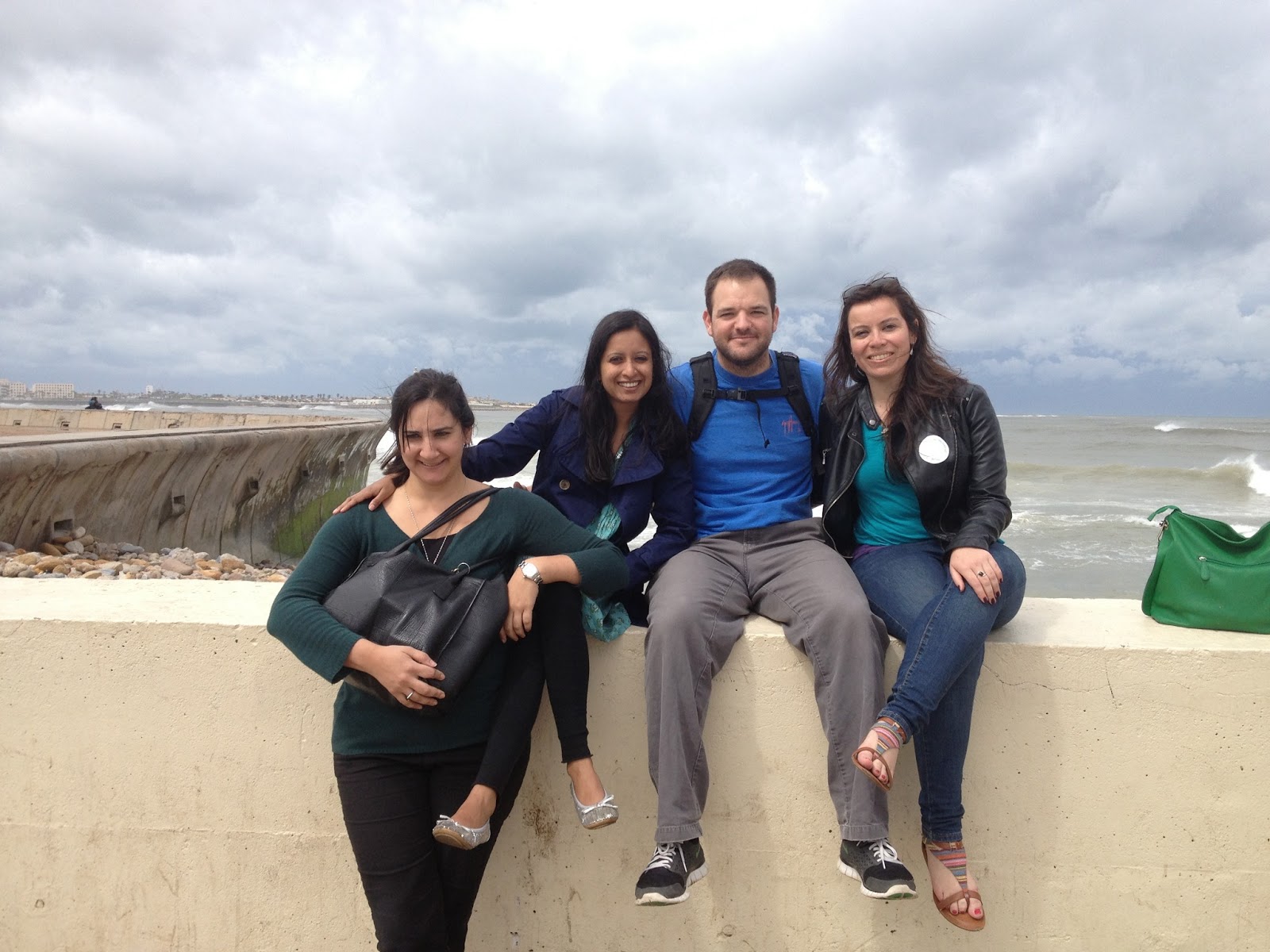
Now we've come full circle back to the White City of Casablanca. A old pirate lair, Casablanca is now the economic capital of Morocco. Unfortunately we experienced our only bad weather here, but we were still able to see the Hassan II mosque, and we had a cocktail at Rick's (even though its the fake Rick's, the real one is in Tangiers - remember, from about 2000 words ago?) We rounded the trip off with a raucous night in a lounge which seemed to love our business. As we departed we were told that is was a laid back place, and no one else had ever shouted songs or house-danced like maniacs. Our international group departed just as we left: in style.
 |
| Mohammed V Square clock tower |
 |
| The Hassan II Mosque |
 |
| The roof of the mosque is retractable like a stadium - seriously. |
 |
| Washroom for cleansing before prayer |
 |
| Casablanca Light |
 |
| My Arabic, Hindi, and Portuguese teachers (I received an F in each) |
 |
| Our guide, driver, and helper stuck with us through it all. |
 |
| The crew looked good in our business wear |
 |
| Papers secured, gin in hand, ready to depart via Lisbon |